work / sorbit

Sorbit

ONE APP FOR THE DUBBING PIPELINE · SELF-FUNDED · NOT OPEN FOR SIGN-UPS YET

Sorbit is where a dubbing studio runs the whole project, from the client's files arriving to the final sign-off.

ROLELed design and product
TEAM5 engineers and me
TIMELINE2025 to now
PLATFORMWeb app
REPLACING8 to 10 separate tools
STATUS150+ users, 4 companies

TL;DR · THE 30-SECOND VERSION

The gap. More content needs dubbing than ever, yet platforms now spend 20 to 25% less on it and want it sooner. Studios always grew by hiring more people. At these prices that stops working, so the work itself had to get faster and cheaper.

What we built. The time went into moving files between eight to ten tools, so Sorbit puts the whole project in one place. The client and freelancers work inside it too, each on their own part. AI drafts each stage and people approve it.

My part. Our CEO set the goal. I led everything after it, including the research, what to build first, the designs and the build plan with our engineers.

What it changed. Translation was the slowest stage, and it went from 5 to 6 days to about a day with proofreading included. Clients now review inside Sorbit instead of on spreadsheets and WhatsApp. And the same team now takes on about three times the projects a month, from about 40 to 120 or 130 when the work is there.

Four calls worth your time. (01) Why shelve the full content pipeline I had designed? (02) How do clients, vendors and freelancers share one platform without seeing the whole show? (03) Why launch with Review, the least exciting stage? (04) Why read the whole show before translating a single line?

CONTEXT

It started with a folder of eighty videos.

Dubbing runs on boring and repetitive tasks. At Sukudo they took far too much time and every deadline turned into chaos. I stepped up and started automating them one small tool at a time. My first script finished eighty videos in three minutes. By hand, that took two hours.

Our CEO noticed, and we started talking about a real product. At first it was going to be just for our studio. Then came the part that shocked me. The whole industry worked this way, and no single app ran the whole process. So why not build it for everyone?

I was asked to lead the product, with two engineers to start.

THE PROBLEM

The dubbing paradox: cheaper to sell, costly to make.

Dubbing is booming. Micro-dramas, YouTube channels and streaming platforms all want their shows in more languages and they want them fast. But the platforms that order the most pay the least. Rates keep falling and deadlines keep shrinking.

1 in 4

Minutes of creators' watch time come from viewers in other languages once dub tracks are added.

YOUTUBE · SEP 2025

Same day

Dubs of big releases used to arrive weeks later. Now they launch with the original.

RED AUDIO · JULY 2026

25% less

Is being spent on dubbing by micro-drama platforms as AI pushes rates down.

INDIAN TELEVISION · MAY 2026

A studio used to answer more work with more people. That stops making sense when each show pays less than the last. The only way to keep up was to make the work itself faster and cheaper.

We spoke to 14 writers, project managers and voice artists about how they worked. The process hadn't changed in years. It ran through eight to ten tools, with a person carrying files between them by hand.

Every arrow is a person downloading, renaming and uploading files by hand.8 to 10 tools

The problem was the process. It cost too much time and money for what the industry now pays, and no tool on the market could replace it.

We built that tool ourselves and called it Sorbit.

THE SOLUTION

If it sells for less, it has to cost less.

Sorbit is how we brought the cost down. It runs a dubbing project as six stages in one place. The client's files arrive in Source and move through translation, casting, recording, subtitling and review without ever leaving it.

The solution was one place where AI drafts each stage and people approve it, so a studio gets through more work and nobody spends a day carrying files between tools.

Each person works in the stage that is theirs. The project manager sees all of them.

Now let's follow one project through Sorbit stage by stage.

SOURCE

Files go straight into the project, not into Google Drive

Project manager's view
The client sends files without an account.Clients won't sign up just to send files. Instead, the project manager sends an upload link that expires in 12, 24 or 48 hours.
Client's view
There's no account and nothing to learn.The link opens a page that only takes files in. The client drops in the episodes while a clock shows how long the link stays open.
Project manager's view
Preparing starts with one click.The project manager clicks Start processing, and Sorbit splits the voices from the music and writes each episode's transcript. Every later stage works on this one copy.

TRANSLATE

Translation waits for the whole story

Project manager's view
Sorbit reads the whole show first.Before it translates a single line, it reads all 90 episodes. It learns who's who, who's related to whom and how they talk to each other. Then all 90 episodes start translating on their own.

TRANSLATE

Writers read every line in less time

Writer's view
Long lines show exactly how much to cut.Writers read every line because the AI can be confidently wrong. This Hindi line runs 1.2 seconds past the actor, so the writer knows what to trim.
Ready means every speaker is confirmed.Sorbit names who's speaking and asks when it isn't sure. Voice artists get their lines by character, so the writer can't send an episode on to casting until every speaker is right.

CAST

Every character gets a voice that fits

Project manager's view
Human or AI is decided per character.Zhao goes to an artist who's already in the workspace. For Chen Hao, Sorbit shortlists AI voices that fit his brief and one gets picked. A lead and a one-line part don't have to cost the same.
One click and recording can start.Each artist gets an email invite to their own lines. AI voices wait in Record until someone generates them.

RECORD

Each artist records only their own lines

Voice artist's view
A scrolling band tells them when to speak.The invite opens straight onto the artist’s own lines. Under the video, each line scrolls along a band toward a red mark, and every word is spoken as it reaches the mark.
Flagging a line doesn't stop recording.This take runs 2.4 seconds while the original runs 1.9, so the artist flags it. The note goes to the writer on that exact line and recording moves on.

SUBTITLE

Subtitles are checked for reading, not for speaking

Subtitler's view
Lines arrive already timed.Each line comes with its text and timing from the script. The reading limit comes from the client's spec, and the subtitler decides what to cut.

REVIEW

The client signs off in the same project

Project manager's view
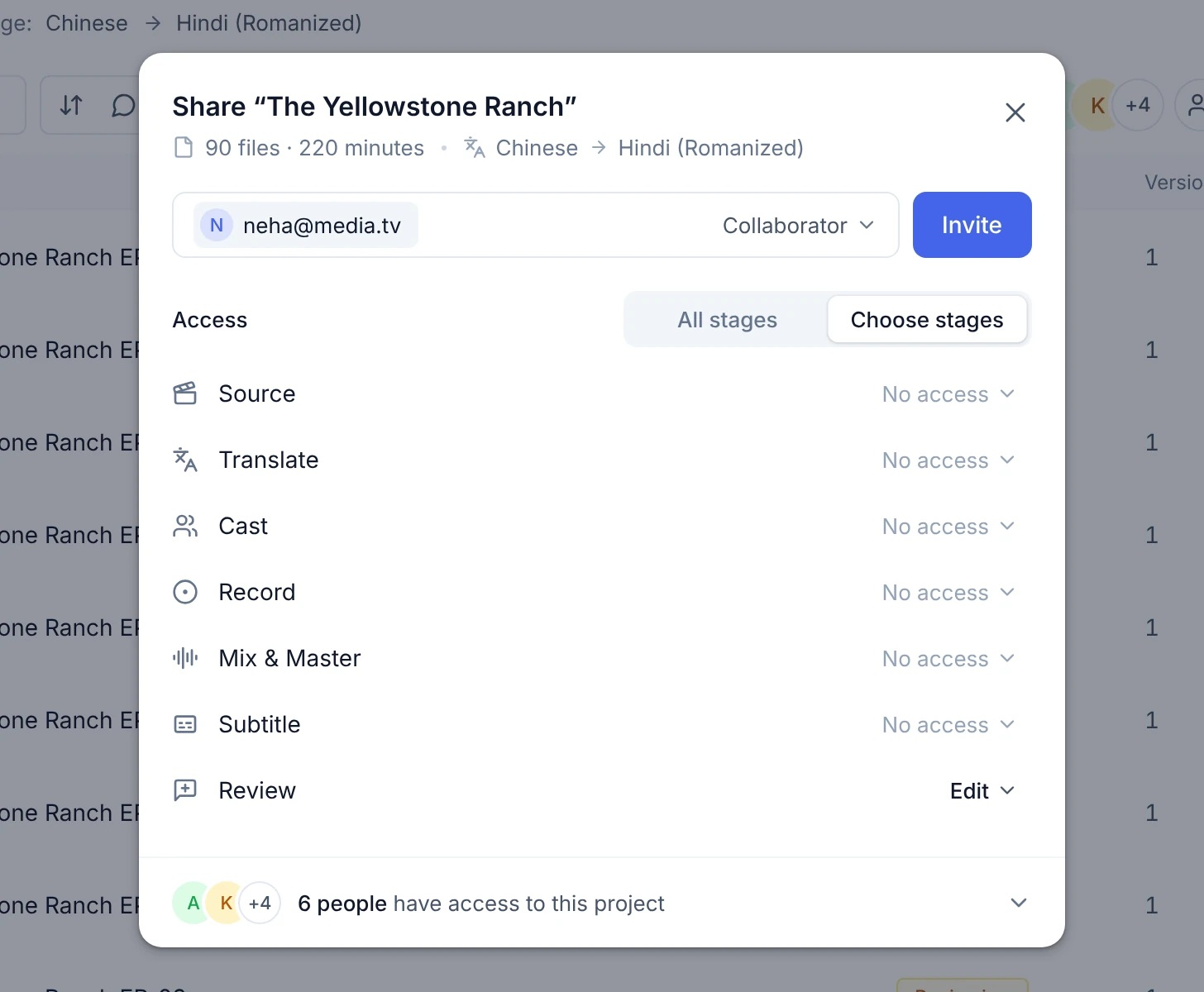
Uploading needed no account. Reviewing does.So only now is the client invited in as a collaborator. They get Edit access to Review and nothing else, so they can leave notes, set each episode's status and move due dates. The other stages stay out of sight.
Every client note reaches the person who can fix it.The client's note arrives pinned to 0:13. The project manager replies with an @ and Sorbit suggests who recorded, mixed and subtitled that line.
Collaborator's view
Every episode gets its own sign-off.Approved episodes don't wait on the ones still being fixed. The client picks the last three and approves them together. That's all 90 done.

That's one project from start to finish. Behind it were a lot of calls about what to build, what to leave out and what to bet on. Here are four of them.

DECISIONS

Four of the decisions that shaped Sorbit

DECISION 01

Choosing dubbing only, and shelving the full content pipeline I had designed

AI is changing how content gets made. Writing a script, shooting or generating the video, editing it and dubbing it used to take four or five separate teams. Now one person can do most of it. When our CEO asked how far Sorbit could go, the answer looked obvious. It was one product that takes you from the first line of a script to the final dubbed video. I believed in it and I designed all of it.

The more I designed, the less sure I got. It wasn't the screens that worried me but the size. Every step in that chain is a market of its own with its own buyers and competitors. We were a small, self-funded team, and the only step we really knew was the last one.

So I argued against my own designs. After weeks of meetings with our CEO and the operations team, we landed on dubbing first.

REJECTEDBuild the whole chain

The bigger market. But it meant three new products at once, each with its own buyers and competitors.

CHOSENStart with dubbing

A smaller market. But it's what our studio had done for nine years, and the clients were already there.

Most new products go looking for their first customer. We already had ours in the clients we dubbed for every day.

It cost us more than two months, and my designs went into a drawer. But building the whole chain with a team our size would have been a disaster.

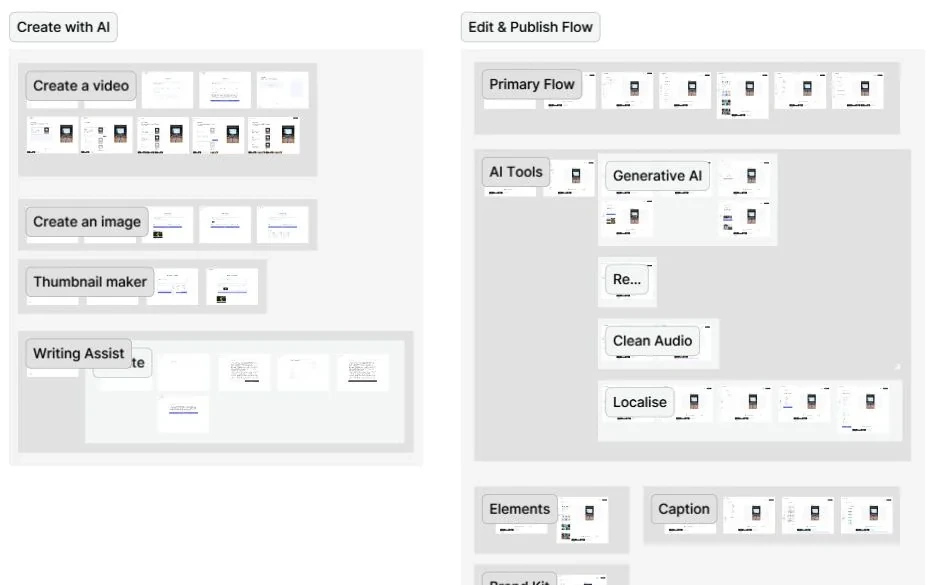
My Figma boards for the create with AI and the edit and publish flows

Create with AI, and edit and publish. Shelved.

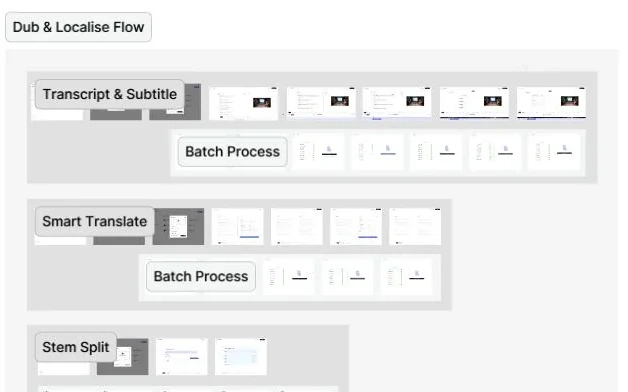
My Figma board for the dub and localize flow

Dub and localize. Built.

I designed all three flows. We built one.

Because we picked the part we knew, Sorbit had people using it from the first release. The content chain is still on the roadmap for when we've got dubbing right.

DECISION 02

Bringing clients, vendors and freelancers onto one platform without exposing the whole show

Every dubbing project pulls in people from outside the studio. There's the company that ordered the dub, its vendors, and freelance proofreaders and voice artists. Before Sorbit, the work moved between them on Drive links, WhatsApp messages and spreadsheets. Nobody had the full picture, so the project manager kept chasing people for updates.

The obvious fix was to bring everyone into one place. But a show is confidential until it launches and nobody wants a leak. Client contracts say only people inside the workspace can see the material. So one place couldn't mean everyone sees everything.

The usual way to split access is by who people are, like client, vendor or freelancer. In dubbing that falls apart on the first real project. A studio is a vendor to the company that hires it and a client to the freelancers it hires. And whoever buys Sorbit owns the workspace. If a client bought it and invited its studio, the studio would become an outsider in its own work.

Client companyCLIENT
HIRES
Dubbing studioVENDOR AND CLIENT
HIRES
FreelancerVENDOR

The same studio is a vendor and a client in the same project.

So access follows what people do, not who they are. One team does the work. Everyone else comes in to send files, review or approve.

A role says what you can do, not who you are.

REJECTEDRoles by who people are

Client, vendor or freelancer. It's easy to read, but the same company plays a different part in every project.

CHOSENRoles by what people do

Admin, Team and Collaborator. The team does the work. Everyone else sees only what they're invited to.

Access is given stage by stage as view, comment or edit. A client can comment on Review without ever opening the script. People are invited to the workspace once instead of project by project. And whoever holds the videos can upload them through a link with no sign-up. The link can add files but never show them. Sending files needs no account, but seeing them does.

Sorbit's share window over the project: the client is invited as a Collaborator, Choose stages is on, and Review is the only stage they can open, set to Edit

Inviting the client takes an email, a role and only the stages they need.

With everyone's work in the same project, the project manager doesn't chase anyone anymore. They can see every stage because every stage happens in Sorbit.
The people outside the studio moved in.

3 companies

Our clients and their vendors work inside Sorbit and no longer swap files on Google Drive.

REVIEW USERS · OCT 2026

20 to 30

Freelancers work in it too, next to our own team.

REVIEW USERS · OCT 2026

DECISION 03

Launching with Review, the least exciting stage, because it was the messiest part of every project

Translation was the part of Sorbit I was proudest of. If any stage was going to sell the product, I was sure it was that one. Review felt like a necessity to me, not magic.

But translation only changes how work gets done inside a studio, and clients would need time to trust a new way of translating. Review was different. It's where a studio meets its clients and vendors on every project, and it's where every project got messy.

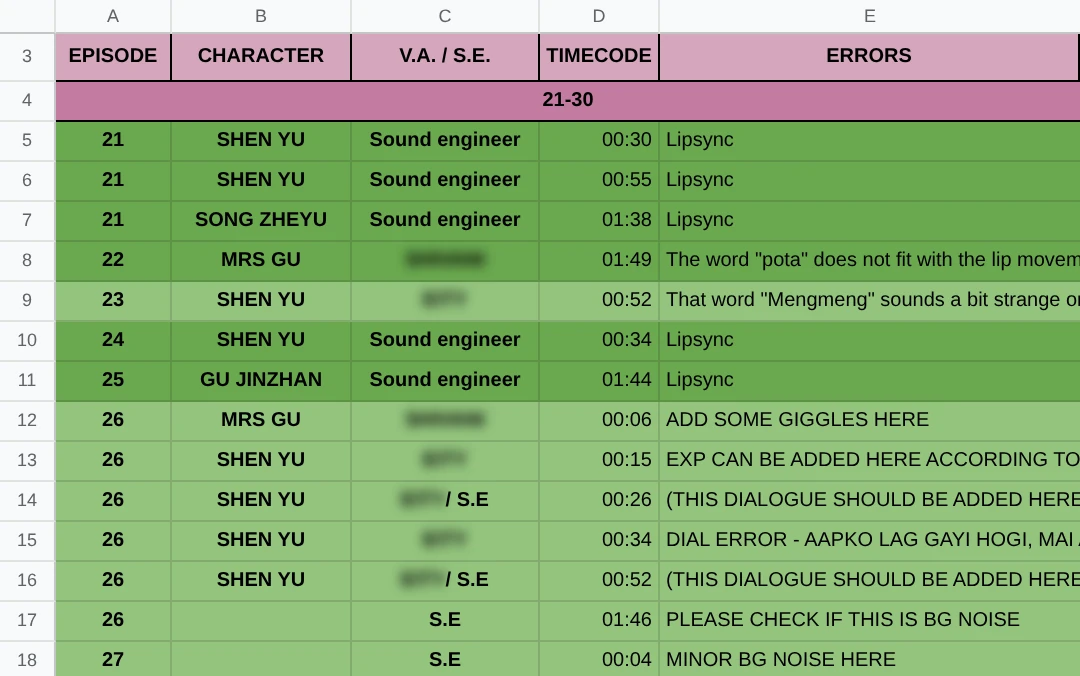
A QC spreadsheet, rows of hand-typed notes for episodes 21 to 27: episode, character, voice artist or sound engineer, timecode, and the error, like 'Lipsync', 'Add some giggles here' and 'Please check if this is BG noise'

QC sheet

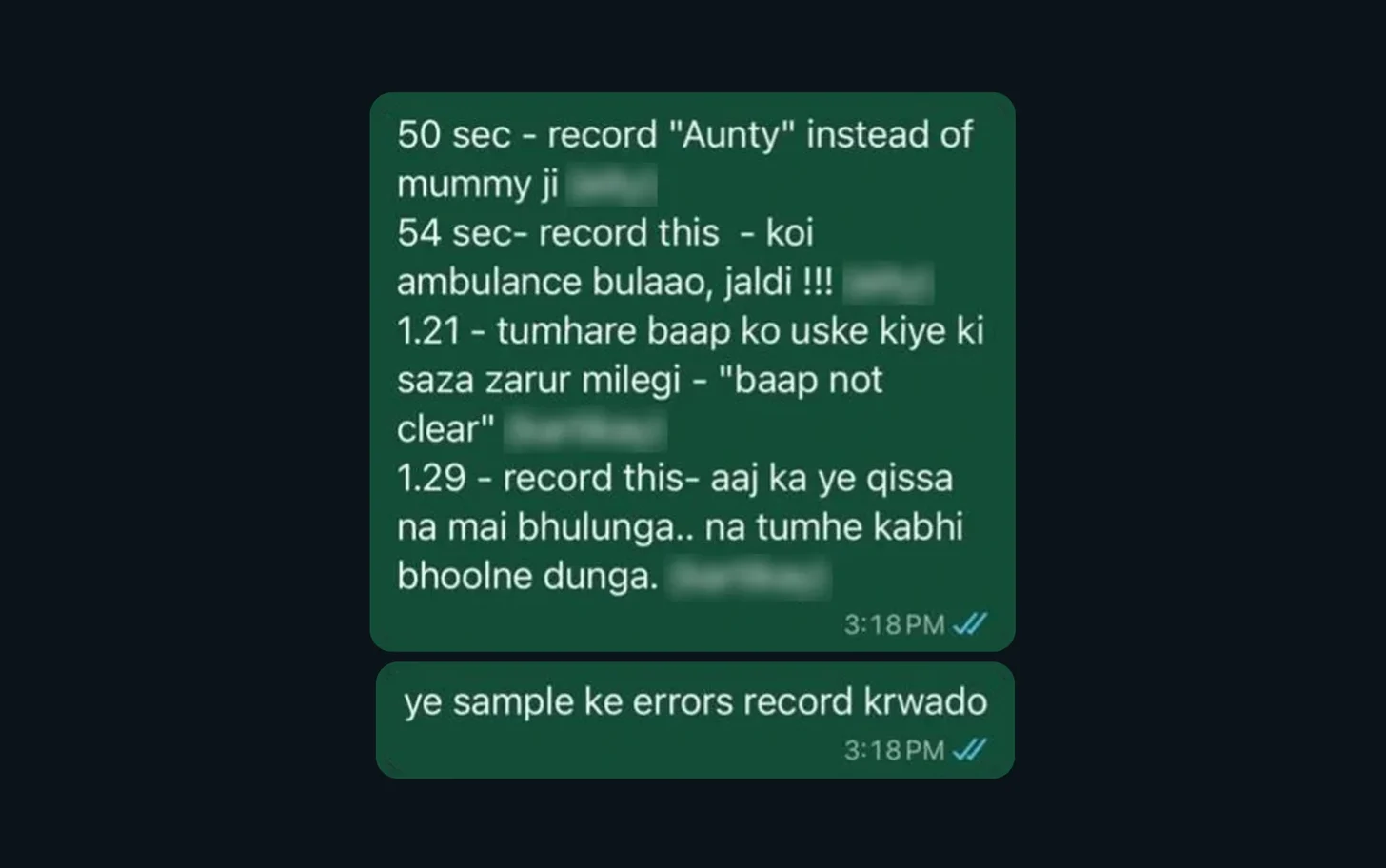
Review notes sent on WhatsApp, one line per timestamp

Notes on WhatsApp, names blurred

Review before Sorbit. Every note had to be matched to the video by hand.

So we launched with Review.

Review didn't need a sales pitch. Every client already had to open it to get their files, and that made it our way in.

REJECTEDLaunch with translation

The bigger idea. But it only helps inside the studio, and clients would take time to trust it.

CHOSENLaunch with Review

The least exciting stage. But every client and vendor already had to use it.

It went to our own team first and then to a small circle of clients and vendors. Building it first also showed me something. Review already had people, roles and workspaces because outsiders had to get in, and the rest of the product had none. Review's people and access model became the base for every stage that came after.

Review became the way in, and it replaced a paid tool.

Dropped

The review tool our studio was paying for. Review in Sorbit does its job now.

OUR STUDIO

Every file

That goes out to a client now goes through Review.

HOW WE DELIVER

DECISION 04

Building a memory of every character and relationship before translating a single line

In dubbing, speed is money. The moment one show is delivered, the client sends the next. Every AI tool we looked at was built for that speed, but only one video at a time. Even the few that took a whole batch translated each video on its own with no memory of the others. Episode one and episode ten didn't sound like the same show.

Our writers worked the same way. They took one episode at a time and kept a sheet of names on the side. The names stayed right, but a sheet can't hold how people talk to each other. And one episode rarely tells you that.

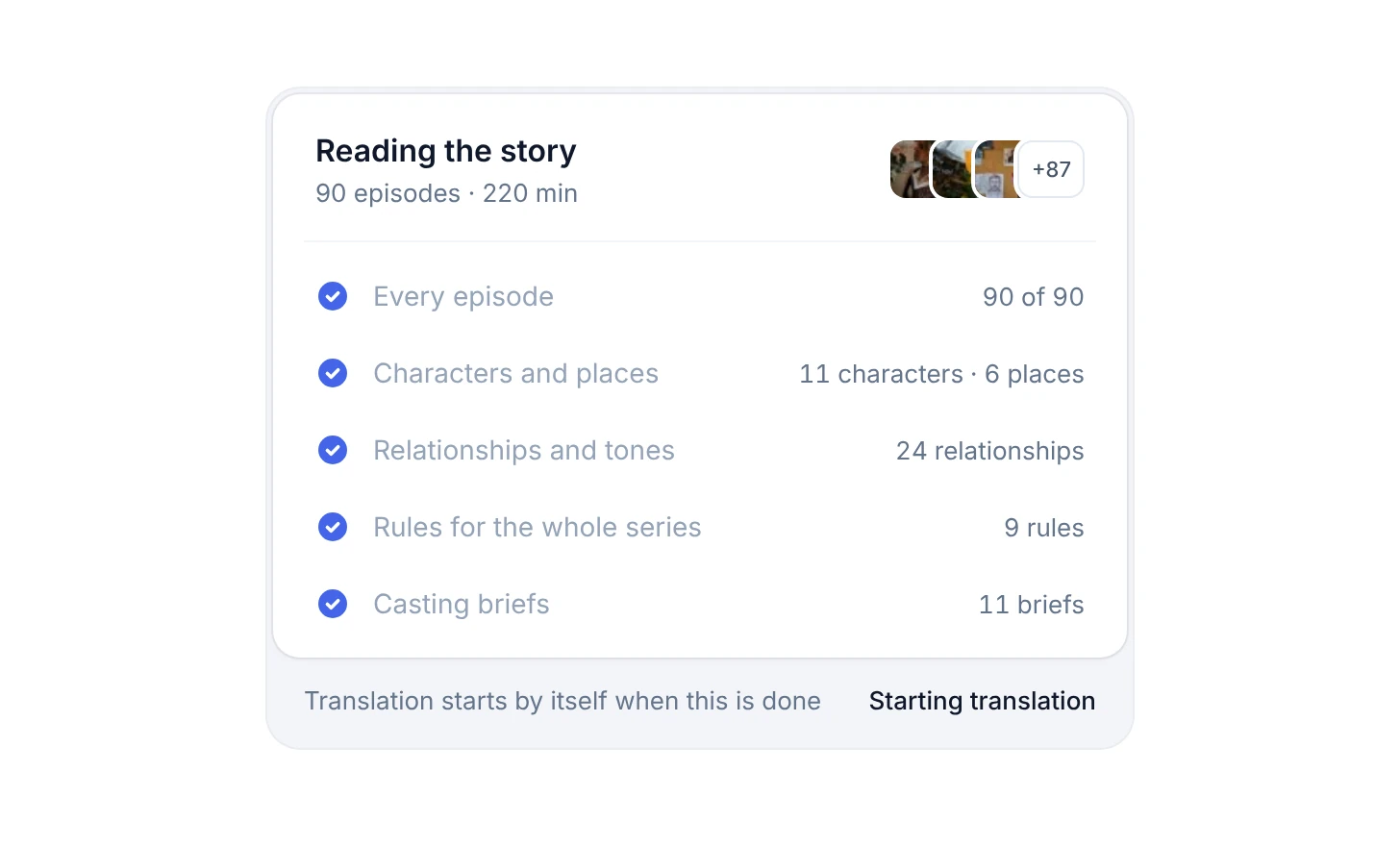
I made Sorbit do the opposite. It doesn't translate a single line until it has read every episode of the show.

Sorbit's Translate stage reading the story: all 90 episodes read, and 11 characters, 6 places, 24 relationships, 9 rules for the whole series and 11 casting briefs found before translation starts

Before the first line, Sorbit reads all 90 episodes and builds one memory of the show.

How two people talk to each other doesn't go wrong inside one episode. It goes wrong across them, and it only shows up at the final review after the voices are recorded. Fixing it means redoing everything that came after translation. A fast translation that comes back for fixes isn't fast.

Sorbit keeps one memory for the whole show instead. It knows who's who, who's related to whom and how they address each other. Every episode is translated with that memory, so episode one and episode ten sound like the same show.

REJECTEDTranslate each video on its own

The way every tool works. But each episode is translated knowing nothing about the others.

CHOSENOne memory for the whole show

Every episode is translated knowing who everyone is and how they talk to each other.

The cost is a wait. Translation can't start until every episode is in and read. Clients usually send the whole show in one go, so the wait is a couple of minutes.

One memory for the whole show, and translation got faster too.

About 1 day

To translate a whole show with proofreading. It used to take 5 to 6 days.

TEAM ESTIMATE

91%

Of lines get the right speaker named, because the memory knows who's who.

AVERAGE ACROSS OUR CHECKS

IMPACT

The same team now takes on about three times the projects.

Sorbit isn't public yet, so these numbers come from where it's used every day. That's our studio and the clients, vendors and freelancers who work in it. They're the studio's own counts and estimates, and each one says where it comes from.

Projects a month with the same team. The count moves with how much work comes in.

About 3x

The projects a month we take on now, against before Sorbit.

STUDIO COUNT · NOV 2026

80 to 90%

Of a first translation draft is right before a writer reads it.

PROJECT MANAGER'S ESTIMATE

150+

People work in Sorbit, at our studio and three client and vendor companies.

USERS · NOV 2026

“Things run smoother now. The targets are clear, we turn work around faster, and we can take on more projects.”

TANYA KAUR, PROJECT MANAGER AT SUKUDO

LEARNINGS

What Sorbit taught me

Design what can ship, then grow it. I could design a feature in a day that took our engineers weeks. Now I design the simplest version that works and ship it.

Expect the scope to move. In an industry AI reshapes every few months, you can't lock a plan. So we built each stage to solve its own problem, whatever happened to the plan around it.

Early decisions run on experience, not data. Some calls come before the numbers exist. I decided on instinct and let real use check me, so every stage went to our own team first.

WHAT'S NEXT

Two things we're building next

A project overview for project managers. Both our project managers asked for the same first screen. They want to see what's waiting on them, where each stage stands and who's falling behind.

Review that catches repeated mistakes. In this kind of content the same errors come back episode after episode. The people using Review every day asked for help spotting them, and that's what we're building now.